

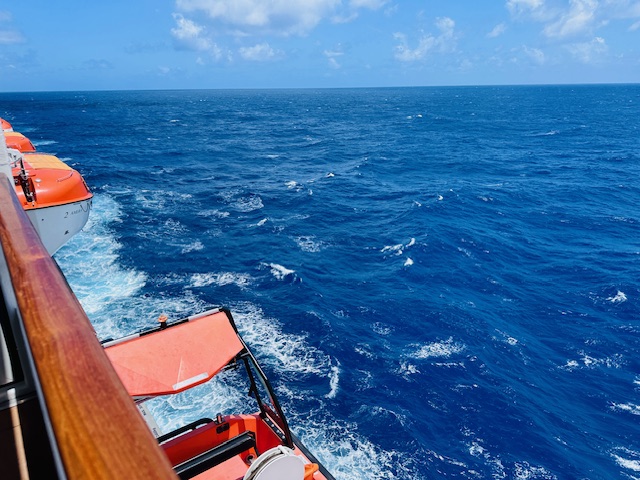
First-time cruisers often worry about rough seas and wind speeds. Many are unsure what a Force 4 wind actually means or what Force 7 feels like aboard a cruise ship. Understanding wind forces at sea can help put the conditions into perspective and allow passengers to set sail with greater confidence and peace of mind.
The Beaufort Scale
Wind strength is measured using the Beaufort scale, which ranges from Force 0, representing complete calm, to Force 12, denoting hurricane-force winds. Originally developed for maritime use, the scale describes not only wind speed but, above all, its effects on the sea and surrounding environment.
At lower wind forces, between 0 and 2, the sea is generally at its calmest. The water is smooth or only slightly rippled, the ship moves gently through the water, and even passengers who are sensitive to motion are unlikely to notice much movement. Such conditions are particularly common in the Mediterranean during summer and are considered ideal for first-time cruisers.
Small Waves from Force 3
From Force 3 or 4 onwards, the sea gradually becomes more lively. Small waves begin to form, and passengers can feel the ship moving gently beneath their feet — a sensation many actually find pleasant. Walking around the deck remains perfectly manageable, although the wind out at sea can feel cooler than expected. A light jacket is therefore worth packing, even in sunny weather.
Always Keep One Hand for the Ship
At Force 5 to 6, winds are described as fresh, making the sea noticeably rougher. Whitecaps appear on the waves, and the ship begins to roll more noticeably. For some passengers, this is when the first signs of seasickness start to appear.
This is precisely when an old seafarer’s rule comes into its own — even aboard modern cruise ships: always keep one hand for yourself and one for the ship. Holding on to railings and taking extra care on stairways can help prevent falls and injuries.
When winds reach Force 7 or 8, conditions become stormy. Waves grow higher, sea spray can sweep across the deck, and exposed areas of the ship may be temporarily closed to passengers. The ship’s movements are now much more pronounced, glasses may rattle, and loose objects should be secured.
Experienced cruisers know that staying near the centre of the ship is particularly advisable in these conditions, as this is generally where the effects of rolling are least pronounced.
Force 12: Hurricane-Force Winds
Winds of Force 9 to 12, ranging from strong gales to hurricane-force conditions, are rare on cruise holidays but can occur, particularly in exposed ocean regions.
Modern cruise ships are engineered to cope safely with a wide range of challenging weather conditions. For passengers, the key is to remain patient and trust the experience of the crew, who continually adjust routes and speeds to suit the prevailing conditions.
The Pacific: An Ocean of Contrasts
How windy a cruise gets depends largely on the region in which the ship is sailing. Overall, the Mediterranean is considered relatively calm, although regional winds such as the Mistral off the French coast and the Meltemi in the Aegean can bring fresh breezes and rougher seas at times.
The Atlantic is far more changeable and is particularly known for stronger winds and heavier seas along northern routes. The Pacific, meanwhile, is an ocean of contrasts. While tropical regions often offer relatively calm conditions, powerful storms can develop in the North Pacific, particularly during winter.
Ultimately, wind is as much a part of life at sea as the salt in the air. Understanding the Beaufort scale and following a few basic safety precautions can help passengers take rougher days in their stride.
With non-slip footwear, a little extra care and the golden rule of keeping one hand for yourself and one for the ship, even a cruise in fresh winds can remain a safe and memorable experience.