


Norway is a dream destination for many cruise travellers: a land of towering cliffs, deep-blue fjords and spectacular natural light displays. Sailing along its rugged coastline reveals a succession of natural wonders at an unhurried pace, with a new port to discover almost every day and ever-changing scenery at every turn. A cruise to Norway is more than just a journey; it is a relaxing passage into a world of tranquillity, crystalline clarity and Nordic magic.

Norway: The Best Cruise Routes
The classic itineraries follow Norway’s western coast to its celebrated fjords, above all the Geirangerfjord and Hardangerfjord. Many cruise lines combine these with calls at Bergen, Ålesund and Stavanger. Routes heading further north are particularly spectacular, venturing towards the Arctic Circle, the Lofoten Islands and as far as Tromsø or the North Cape. The further north you travel, the more remote and untamed the landscape becomes. Expedition cruises to the Arctic archipelago of Svalbard offer another kind of adventure, with glaciers, vast seabird colonies and ice-fringed fjords.

Norway’s Most Beautiful Fjords
Norway’s fjords rank among Europe’s most spectacular natural landscapes and are a major reason why millions of travellers choose to cruise the country each year. Over thousands of years, immense glaciers carved deep valleys into the rock. When the ice retreated at the end of the last Ice Age, seawater flooded these valleys, creating a remarkable coastline of sheer cliffs, crystal-clear water, snow-capped peaks and countless waterfalls. Viewed from the deck of a cruise ship, the scenery is particularly breathtaking. Many of Norway’s most beautiful fjords reveal their full splendour only when approached from the water.

Geirangerfjord – Norway’s Most Famous Postcard View
Few fjords are as instantly recognisable as the Geirangerfjord. Together with the Nærøyfjord, it forms part of a UNESCO World Heritage Site. Stretching for around 15 kilometres, the fjord winds between cliffs that rise to heights of up to 1,000 metres. Its most celebrated sights are its spectacular waterfalls, including the Seven Sisters, the Suitor and the Bridal Veil.
Arriving by cruise ship in the early morning is an especially memorable experience. Wisps of mist drift across the water as the first rays of sunlight illuminate the mountain peaks, transforming the fjord into a scene of almost otherworldly beauty.
The small village of Geiranger is an ideal starting point for excursions. Popular options include a drive along the famous Eagle Road, with its dramatic hairpin bends, and a visit to the Dalsnibba viewpoint, which offers sweeping panoramas across the fjord and surrounding mountains.

Sognefjord – King of the Fjords
At more than 200 kilometres long, the Sognefjord is Europe’s longest and deepest fjord. It reaches far inland, branching into numerous side fjords, each with its own distinctive character. Along its shores, green orchards and small villages give way to imposing mountain scenery and mighty glaciers.
One of the highlights is the narrow Nærøyfjord, among the most spectacular branches of the Sognefjord. In places, sheer rock walls rise just a few hundred metres apart, making the passage through the fjord an unforgettable experience for cruise passengers.

Hardangerfjord – A Sea of Blossom in Spring
The Hardangerfjord is one of southern Norway’s most beautiful fjords and is particularly renowned for its orchards. In spring, millions of apple, cherry and plum trees burst into bloom, covering the region in a sea of colour. In summer, an extensive network of hiking trails and scenic viewpoints invites visitors to explore the landscape on foot.
Not far from the fjord lies Vøringsfossen, one of Norway’s best-known waterfalls, where water plunges almost 180 metres into the depths below. Trolltunga, a dramatic rock formation jutting out over the landscape, is another of the country’s most famous natural attractions.

Lysefjord – Home of Preikestolen
For lovers of dramatic rock formations, the Lysefjord is a must. Around 40 kilometres long, it is framed by towering granite walls and ranks among southern Norway’s most popular destinations for outdoor excursions.
High above the fjord stands Preikestolen, or Pulpit Rock, a vast natural rock platform some 600 metres above the water. The views from its edge are among the most iconic in Scandinavia. Nearby, Kjerag attracts hikers and photographers keen to see the famous boulder wedged between two rock faces.

Nordfjord – Between Glaciers and Green Valleys
Quieter than some of Norway’s better-known fjords, Nordfjord is no less impressive. It leads deep into a varied landscape of green valleys, rugged mountains and immense glaciers. Excursions from the area offer opportunities to explore Jostedalsbreen, the largest glacier on mainland Europe.
The striking contrast between snow-covered peaks and fertile valleys gives Nordfjord a character all its own.
Norway’s appeal, however, extends far beyond its spectacular fjords. The charming port towns scattered along the coast are an essential part of the cruising experience. Each has its own identity, from historic Hanseatic trading cities and lively fishing villages to modern urban centres beyond the Arctic Circle. Whether culture, nature or local cuisine is the priority, every port offers memorable experiences and a wealth of excursions.
Norway’s Most Beautiful Cruise Ports

Bergen – Gateway to the Fjords
Bergen is one of Norway’s most popular cruise ports and is known, quite rightly, as the Gateway to the Fjords. The former Hanseatic trading city charms visitors with Bryggen, its historic waterfront district. The colourful wooden buildings have shaped the city’s skyline for centuries and are now part of a UNESCO World Heritage Site.
A stroll through the narrow lanes leads past independent boutiques, craft shops and cosy cafés. One of the best ways to take in the city is to ride the Fløibanen funicular up Mount Fløyen. From the summit, panoramic views stretch across Bergen, its harbour and the surrounding fjords. Those keen to sample fresh fish and regional specialities should make time for the famous fish market.

Ålesund – An Art Nouveau Gem by the Sea
Few Norwegian cities are as elegant as Ålesund. After a devastating fire in 1904, much of the city was rebuilt in the Art Nouveau style, making it one of Europe’s finest examples of the architectural movement. Ornate façades, decorative turrets and intricate bay windows give the city a distinctive atmosphere. A favourite destination is the Aksla viewpoint, reached by climbing around 400 steps or taking a bus. The reward is a spectacular panorama of the islands, harbour and surrounding mountains. Ålesund is also an excellent base for excursions to the Geirangerfjord and the striking Atlantic Ocean Road.

Tromsø – Gateway to the Arctic
Far above the Arctic Circle lies Tromsø, one of Norway’s most fascinating cities. Often described as the Gateway to the Arctic, it has served for centuries as a starting point for polar expeditions. The Arctic Cathedral, with its striking modern architecture, is among the city’s best-known landmarks. Visitors can take the Fjellheisen cable car to Storsteinen for sweeping views across Tromsø and the surrounding islands. In winter, the Northern Lights draw visitors from around the world; in summer, the midnight sun bathes the landscape in an almost magical glow.
Stavanger – Where History Meets Nature
Stavanger combines a charming old town with access to some of Norway’s most spectacular natural attractions. The white wooden houses of Gamle Stavanger, the city’s historic quarter, are among the best-preserved examples of their kind and make for a leisurely stroll through the past. The city is also a popular starting point for excursions to the nearby Lysefjord. One of the most sought-after adventures is the hike to Preikestolen, the dramatic rock platform that rises some 600 metres above the fjord.
Honningsvåg – Gateway to the North Cape
At the northernmost reaches of Norway, the small port town of Honningsvåg serves as the starting point for many excursions to the legendary North Cape. Its towering cliffs overlook the Arctic Ocean, offering a sense of vastness that makes the visit one of the emotional highlights of a Norwegian cruise. The town itself is worth exploring, too, with small shops, cafés and an engaging museum devoted to life in the Arctic.
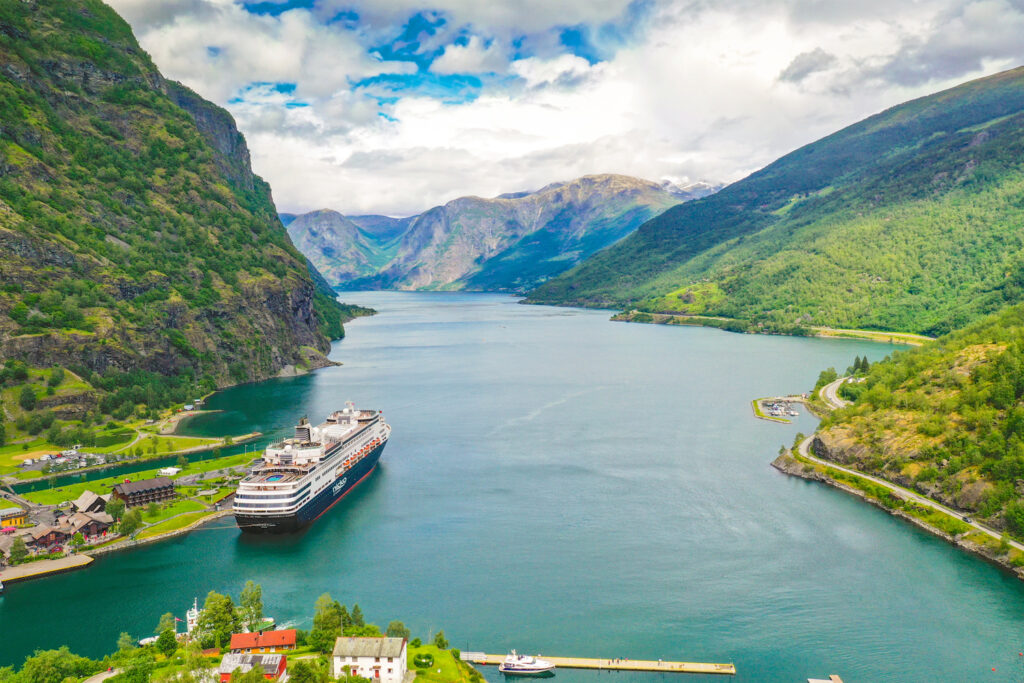
Flåm – An Idyllic Village on the Aurlandsfjord
With only a few hundred residents, Flåm is nevertheless one of Norway’s best-known cruise ports. Nestled between steep mountains at the head of the Aurlandsfjord, the village welcomes visitors with a spectacular natural backdrop.
Flåm is best known for the Flåm Railway, widely regarded as one of the world’s most scenic train journeys. The line winds through deep valleys, past thundering waterfalls and across rugged mountain terrain, covering a dramatic change in elevation over a relatively short distance. Even the cruise ship’s approach through the narrow fjord is a highlight of any Norwegian voyage.
Kristiansand – Sunny Harbour City of Southern Norway
Kristiansand offers a relaxed atmosphere, broad sandy beaches and an attractive old town. As a cultural centre of southern Norway, it is particularly popular with families. Around the main square, pavement cafés and small shops invite visitors to linger. Those with more time can explore the nearby skerries or take a scenic excursion along the picturesque southern coast.

Oslo – Norway’s Vibrant Capital on the Oslofjord
Oslo combines Scandinavian ease with urban sophistication, making it one of Norway’s most popular destinations for cruise passengers. The approach through the Oslofjord, which extends for roughly 100 kilometres, is an experience in itself. The ship passes small islands, picturesque coastal communities and green shorelines before docking in the heart of the Norwegian capital. From there, many of the city’s principal attractions are within easy walking distance.
Highlights include the contemporary Opera House, with its walkable roof; the imposing Akershus Fortress; the new MUNCH Museum, home to works by the celebrated painter Edvard Munch; and the lively waterfront district of Aker Brygge, lined with restaurants, cafés and shops. Also worth visiting are Vigeland Park, with its more than 200 sculptures, and the Norwegian Museum of Cultural History on the Bygdøy peninsula, which offers fascinating insights into the country’s heritage and traditions.
Oslo is not just a port of call on a longer Norwegian cruise; it also makes an excellent destination for a short break. Color Line’s popular mini-cruises run daily between Kiel and Oslo. The comfortable ships offer a genuine cruise experience even during the crossing, with restaurants, bars, a promenade, spa facilities and a varied entertainment programme.
After a relaxing night on board, passengers have several hours to explore Oslo before setting sail for Germany again in the evening. These short breaks can be an affordable way to discover the Norwegian capital, even for travellers who are not planning a longer trip to Norway.

Norway Cruises: When Is the Best Time to Go?
Summer is the most popular season for a Norwegian cruise. From June to August, generally favourable weather and the midnight sun bring long, golden days, ideal for extended shore excursions. In northern Norway, the sun remains above the horizon for weeks at a time. Watching the ship glide through shimmering fjords late at night, with no real darkness to speak of, is an extraordinary experience.
Winter has its own appeal. From October to March, the Northern Lights frequently illuminate the sky, particularly in the north. Cruise operators, notably Hurtigruten and Havila Voyages, offer dedicated winter itineraries designed to give passengers opportunities to witness the aurora. Snow-covered mountains and crisp polar air lend the journey an almost meditative quality.
Norway Cruises: Which Ships Should You Choose?
For travellers looking to experience Norway’s coastline in depth, the legendary Hurtigruten is hard to overlook. Its coastal vessels have connected small ports between Bergen and Kirkenes for more than 130 years. Their relatively low profile and unhurried pace make them particularly well suited to taking in the coastline’s details.

Havila Voyages is another option, operating a fleet of four ships designed with an emphasis on environmental performance and serving some of the country’s most spectacular fjords.
Traditional ocean-going cruise ships offer a comfortable alternative. One advantage is that many itineraries begin and end in northern Germany, eliminating the need for a lengthy journey to the departure port.
Environmental regulations are also changing the cruise experience. From 2026, smaller passenger vessels and ferries with a gross tonnage of up to 10,000 that cannot meet the applicable zero-emission requirements are no longer permitted to enter certain fjords.

Norway Cruises: Unforgettable Shore Excursions
Whether travelling in summer or winter, Norway offers experiences that are difficult to find elsewhere. Popular excursions include walks to the Ørnesvingen viewpoint overlooking the Geirangerfjord and hikes to Preikestolen near Stavanger. On the Lofoten Islands, traditional fishing villages and spectacular photographic viewpoints are major draws.
In winter, dog-sledding, snowmobile adventures and visits to Sámi reindeer herders are among the most popular activities. Travellers looking for a more leisurely experience can take the Flåm Railway, one of Europe’s most scenic rail journeys.
What to Pack for a Norwegian Cruise
Norway’s weather can be as changeable as its scenery. Even in midsummer, temperatures may range from a pleasant 25°C in the cities to just a few degrees on mountain summits or during a passage through the fjords. Wind, rain and occasional dense fog add to the mix.
The golden rule for a Norwegian cruise is to dress in layers. Several lightweight layers can be combined as conditions change, ensuring you stay comfortable whatever the weather brings.
Clothing for Every Kind of Weather
A windproof, waterproof jacket is an essential item on any Norwegian cruise. The wind on the open decks can feel surprisingly cold, even when summer temperatures prevail ashore. Pack fleece jackets or warm jumpers, T-shirts, long-sleeved tops and comfortable trousers. If you are travelling during the summer months, bring some lighter clothing as well, since sunny days can be unexpectedly warm.
For excursions into the countryside or shorter hikes, sturdy, comfortable footwear with good grip is highly recommended. Lightweight trainers are ideal for exploring cities, while waterproof hiking boots offer considerably more comfort on trails leading to viewpoints and waterfalls.
Rain Gear and Weather Protection
Norway is famous for its unpredictable weather. A compact umbrella or, better still, a good-quality waterproof jacket with a hood should always be within easy reach. Lightweight waterproof trousers can also be useful on longer excursions.
A hat, scarf and thin gloves might seem unnecessary in summer, but they can quickly become indispensable on a fjord cruise or a trip to the North Cape. Travellers visiting in spring, autumn or winter should plan for substantially colder conditions.
What to Wear on Board
Life on board is generally relaxed during the day, and comfortable casual clothing is perfectly adequate. If you intend to use the spa or pool facilities, pack swimwear, pool shoes and, if needed, a lightweight dressing gown.
Many cruise lines organise formal dinners or gala evenings on selected nights. For these occasions, smarter clothing is advisable: a shirt and jacket for men, for example, or a dress or elegant blouse with trousers for women. It is best to check your cruise line’s dress code before departure.
Practical Extras
A small daypack makes shore excursions easier and provides space for a water bottle, camera, rain jacket and souvenirs. Reusable water bottles are another practical and environmentally friendly choice.
Sunglasses, sunscreen and lip balm are often overlooked. Yet sunlight can be surprisingly intense, particularly on the water or in the mountains. Travellers heading north of the Arctic Circle in summer should also consider packing a sleep mask, as the midnight sun can keep the nights remarkably bright.