


Only two traditional coffee stands remain in the Port of Hamburg, serving shift workers and truckers hearty, honest home cooking. At her stand, Magdalena Meierdirks has been serving food since early morning for decades. But she offers more than a good meal: a Hamburg original, she is also a trusted source of news and the latest port gossip.
With red geraniums spilling from window boxes, a garden bench, tables surrounded by white plastic chairs, and standing tables tucked beneath a bright red awning, the entrance to Zum Lütten Foffteiner is a splash of color against the red-brick warehouses and gray terminal buildings along Dessauer Straße. Run by Magdalena Meierdirks, known to everyone around the port simply as Lena, this beloved local institution is a little oasis amid the harbor’s relentless activity—a place to take a breather. The name comes from the port’s own slang. In Hamburgs Low German, “Fofftein” refers both to the breakfast break, which once lasted just 15 minutes, and to a short work break around 3 p.m.
The stand is bustling in the morning and around lunchtime, drawing a colorful cross-section of port life: truckers in worn leather vests, dockworkers in blue coveralls, police officers and customs officials in uniform, terminal security staff, managers in ties, and curious tourists. The most frequent customers, however, are also the surest testament to Lena’s cooking: dockworkers and long-haul truckers. They know exactly where to find a satisfying, hearty meal. Meat patties, Bauernfrühstück—a traditional farmer’s breakfast of potatoes and eggs—currywurst, and, especially in the morning, rolls topped with seasoned raw pork are among the favorites.
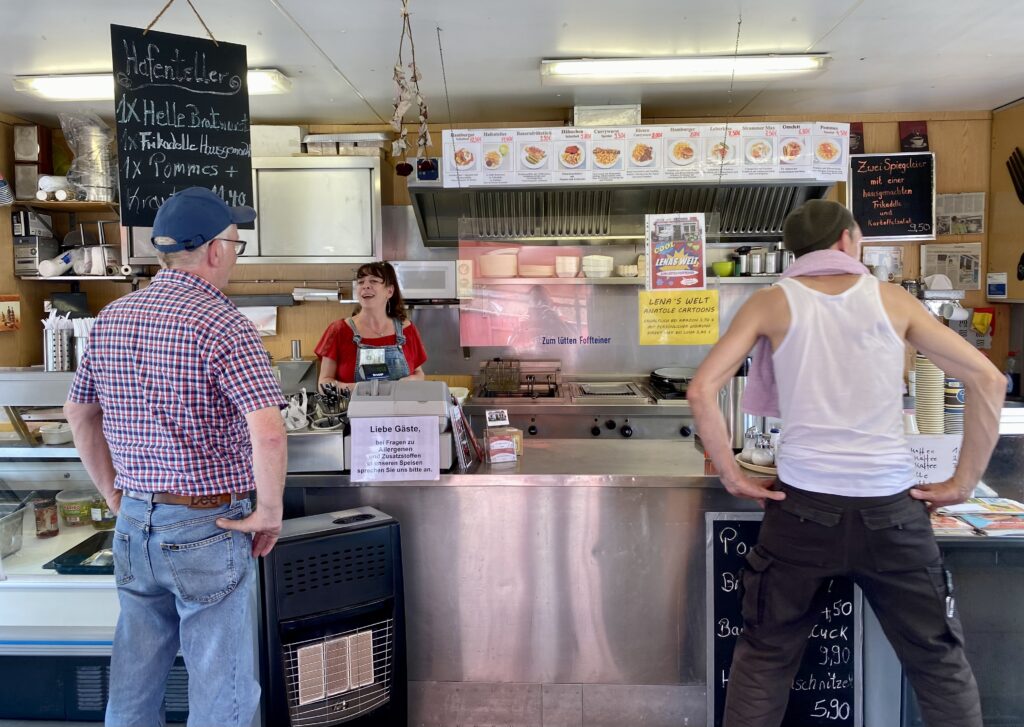
Coffee, Conversation, and a Little Harbor Humor
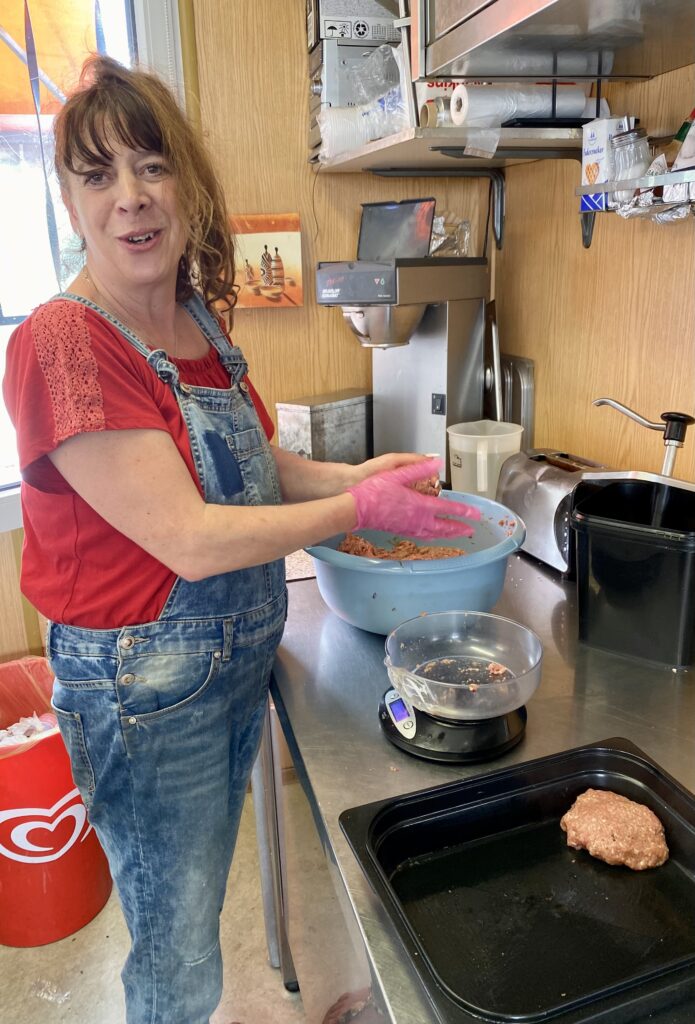
Lena’s regulars come for more than the food. They come for Lena herself. A true Hamburg native, she is a force of nature who never hesitates to speak her mind. A trained early childhood educator who has spent nearly her entire working life in the food service business, she keeps customers entertained with a steady stream of off-the-cuff quips. The banter is characteristically rough around the edges, but always warmhearted. Lena’s wit is legendary, and her sunny disposition is infectious. For more than 20 years, she has been serving coffee and conversation from 7 a.m. onward. Her easygoing atmosphere rubs off on everyone who walks through the door. More than a few difficult contract negotiations and deadlocked wage talks have reportedly found an amicable resolution over schnitzel and currywurst at Lena’s place. On weekdays, Lena rises early and gets to work in the tiny kitchen housed in two 20-foot shipping containers bolted together. She assembles sandwiches at a furious pace, fries batches of meat patties, chops potatoes, and pounds schnitzels thin. By 7 a.m. sharp, when the doors open, the first customers are already waiting for steaming cups of coffee and breakfast rolls. The 58-year-old works behind the counter until 4 p.m., then regularly heads to a wholesale supplier in the afternoon to stock up on fresh ingredients. By the time she finishes the books, her workdays can stretch to a full 14 hours. But she enjoys both the work and the chance to connect with people. Without that enthusiasm, the demands of the job would be difficult to sustain.
An Uncertain Future in a Changing Port
Lena’s location on Kleiner Grasbrook is ideal. Right next door is HHLA’s O’Swaldkai terminal, a massive transshipment hub for fruit and automobiles that brings a steady stream of workers and pickup drivers to the area. Although Lena has faced the threat of eviction several times as the entire district is slated for redevelopment into a new urban neighborhood called Grasbrook, she continues to hold her ground. Still, it is clear that her shipping containers will eventually have to go. Lena, however, has no intention of leaving the area. Her many regulars would almost certainly follow her to another location in the port. After all, her stand offers something increasingly rare: a place where anyone can drop in, satisfy their hunger and thirst without ceremony, laugh at a few earthy jokes, and simply unwind.
At a glance
Zum Lütten Foffteiner
Monday–Friday, 7 a.m.–4 p.m.
Dessauer Straße 10
20457 Hamburg, Germany
Coffee Stands: A Tradition Inspired by London
The idea for portside food stands came from London in the 19th century. Life for dockworkers was brutally hard, double shifts were commonplace, and alcohol abuse was an increasing problem that contributed to numerous accidents. Along the River Thames, authorities and reformers tackled the problem by setting up small stalls in the docks where workers could buy tasty meals and nonalcoholic drinks at low prices. In Hamburg, the “Committee for the Establishment of Public Coffee Halls” was founded in 1884 with the aim of providing people of limited means with inexpensive, nutritious food. The outlets quickly acquired the popular nickname Kaffeeklappen, roughly “coffee hatches,” because hot drinks and food were passed through a small hatch to customers outside. Coffee was not yet a particularly common drink among working-class communities at the time. But it was served because experience in London had shown that the hot beverage helped workers stay more alert and focused.